Profit Loss SpreadsheetClassified rows wait for the match
Profit is the rollup beside a statement that already agrees.
The order is the whole point
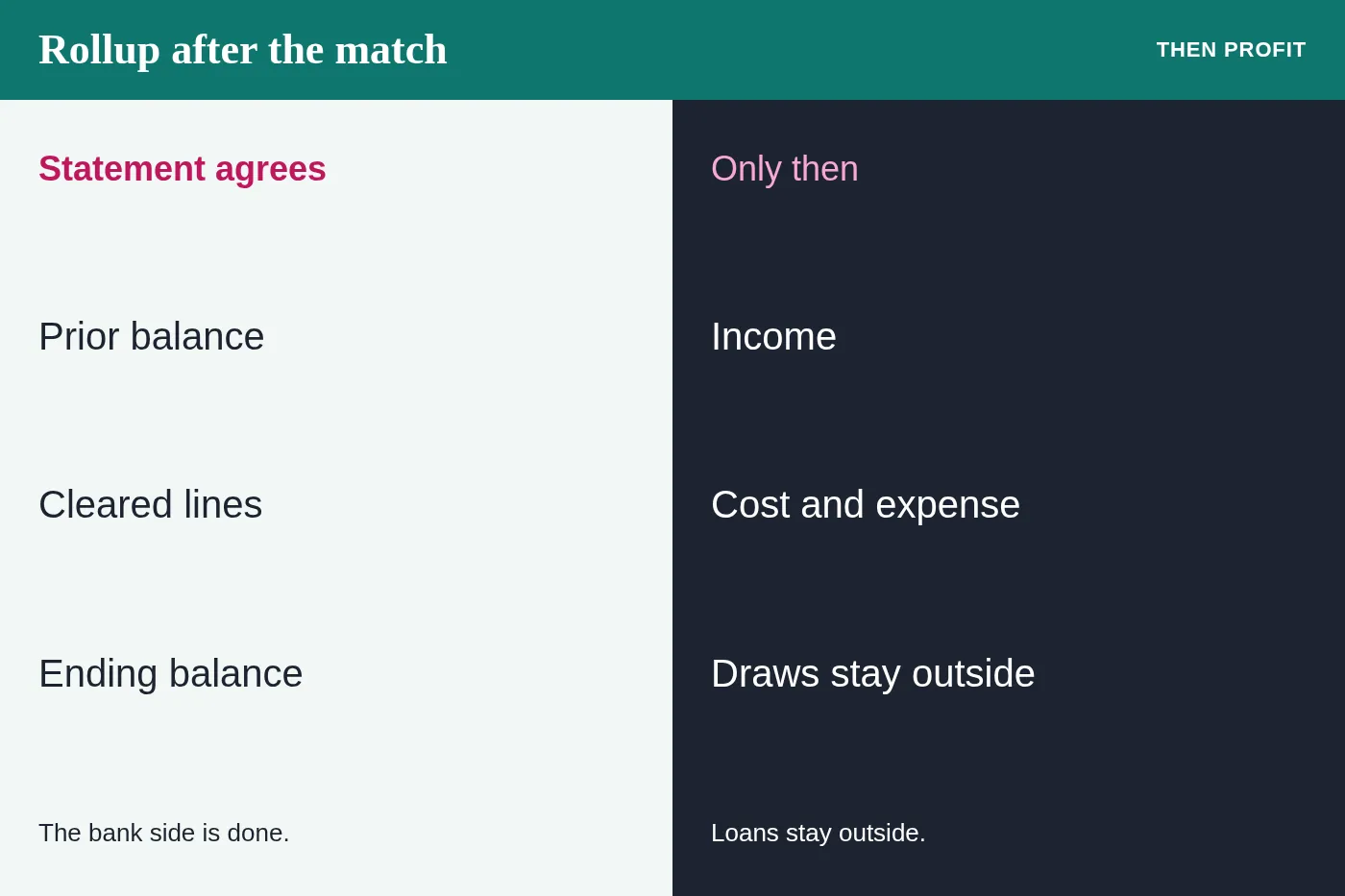
A file can show income, cost, and expense in handsome groups and still be wrong, if the groups were filled before anyone checked the bank. Classification waits until the statement agrees, and only a line that already cleared may enter a group after that.
That order feels slow the first time, and it feels kind the second time, because the profit cell stops jumping every time a deposit is reclassified. The jump was never a change in the shop. It was a change in a label.
What is allowed into the rollup
Sales for work that is finished. Costs that belong to those sales. Expenses of running the shop. Those three can add to profit. A customer payment for work that is not finished stays out until the work is done, even though the cash is already in the bank. The cash column tells one story. The profit column tells another. Both can be true.
Draws, loan proceeds, loan principal, and transfers between your own accounts stay out. They are real. They are just not profit. A lender who later asks how cash moved will want those columns, and a return that treats them as sales will not survive the question.
One month, shown as a shape
Picture a month with no amounts attached, because a sample dollar would be a fiction. The statement ending balance is the target. Cleared operating lines sit in income, cost, and expense. A deposit that is still owed back to a customer sits in a holding account. Owner cash that left the company for personal use is recorded as a draw, and that draw never joins income, cost, or expense. The profit cell is whatever remains after that sorting, and it is allowed to be quieter than the bank.
If your profit cell is louder than the bank, the usual cause is a deposit that was not sales. If the profit cell is quieter, the usual cause is a personal payment coded as a cost, or a loan payment coded entirely as an expense when part of it was principal. The columns separate those pieces without inventing a story.
Why the return cares about the order
A return prepared from a rollup that never matched the statement is a set of round guesses. Meals, depreciation, and owner pay are the usual places the books and the form use different widths. Writing those differences down still leaves an unmatched month sitting there unmatched.
Federal estimate dates do not wait for the file to get brave. April, June, September, and January arrive on the same days in every state. A voucher sized from a rollup that includes a loan will overstate the year. A voucher sized from a rollup that expenses your draws will understate it. Either surprise can become a letter. The match is how we keep the letter from being the way you learn.
Say whether the profit cell is ahead
You will be talking to the Steven Palmieri practice.